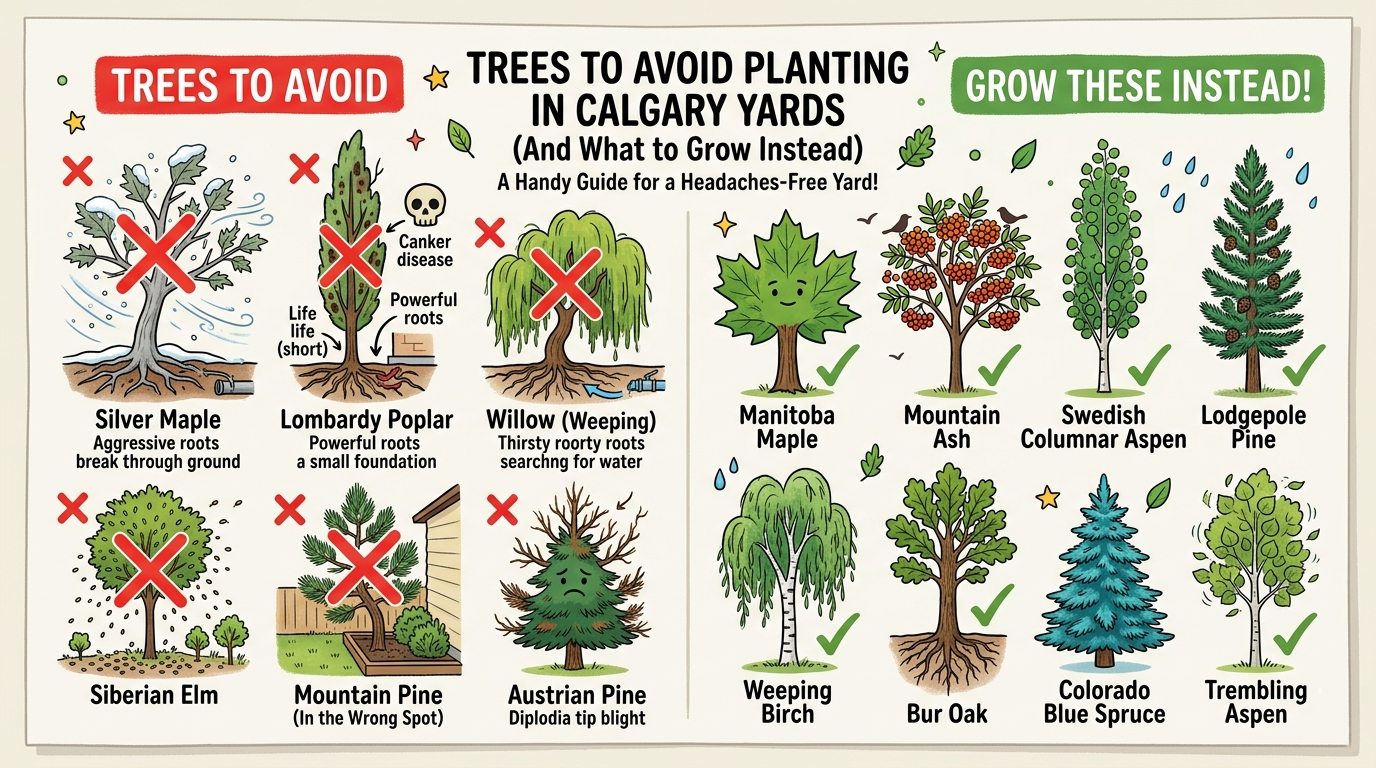
Trees to Avoid Planting in Calgary Yards (And What to Grow Instead)
Every spring, garden centres fill up with trees that look great on a tag and perform terribly in Calgary. Some are wrong for our climate. Some are technically winter-hardy but cause years of headaches with their roots or their brittleness or their disease problems. Some are just not worth the trouble given what you are giving up in space and money to plant them.
This is a list of trees that come up regularly in conversations between homeowners and arborists, usually in the context of “why is this dying” or “how do I get this root out of my pipe.” It is not exhaustive, but it covers the ones that cause the most problems in Calgary yards.
Silver Maple
Silver Maples grow fast. That is their main selling point and it is also the source of most of their problems.
Fast growth means weak wood. Silver Maple branches break in wind and heavy snow, which Calgary delivers regularly. After a significant storm, calls about broken Silver Maple branches make up a disproportionate share of emergency tree service calls. The wood just does not hold up.
The root system is aggressive and shallow. Silver Maples send roots out looking for water and they find it in irrigation lines, drainage pipes and foundation cracks. If your Silver Maple is within 10 metres of any underground infrastructure, that infrastructure is eventually going to have a problem.
They also leaf out early in spring, which makes them vulnerable to late frosts. We get late frosts in Calgary. Sometimes we get them in May. A Silver Maple that has fully leafed out and then gets hit by a hard frost is going to look terrible for the rest of the season.
What to plant instead: If you want a maple in Calgary, a Manitoba Maple is hardier and more manageable, though it has its own issues with weak crotches. A Mountain Ash gives you similar height with better structure and wildlife value.
Lombardy Poplar
People plant Lombardy Poplars because they grow fast and create a tall, narrow screen quickly. Both things are true. What is also true is that they typically live only 15 to 20 years, they are heavily susceptible to fungal canker disease in Alberta and their roots are among the most aggressive of any tree you can plant.
A Lombardy Poplar root system will travel a long way to find water. If you have one planted near your house, near your sewer line or near a neighbour’s infrastructure, the roots will eventually get there. When they do, the damage is not cheap to fix.
At the end of a Lombardy Poplar’s life, you are left with a large dead tree that needs to be removed, often in an awkward location given where these things typically get planted, and then the root system to deal with afterward.
What to plant instead: Swedish Columnar Aspen gives you a similar narrow, upright shape with a smaller root system. Lodgepole Pine gives you a narrow evergreen option that lasts much longer.
Willow (especially Weeping Willow and Globe Willow)
Willows and water go together, which is why willows send their roots aggressively toward any water source they can detect. In a natural setting next to a creek or a pond, that is fine. In a suburban yard in Calgary with underground irrigation, a water main and a sewer line within reach, it is a serious problem.
Globe Willows are additionally prone to structural failure as they age. The multiple upright stems create tight, included bark junctions that are inherently weak, and large sections can split off with very little warning.
Weeping Willows are beautiful. If you have a large acreage property with a natural water feature and no underground infrastructure within 30 or 40 metres, a Weeping Willow can work. In a city lot, it is not a good fit.
What to plant instead: If you want a tree with attractive drooping branches, a Weeping Birch is more manageable in a suburban setting, though you will need to watch for bronze birch borer. If you want fast growth and shade, a Bur Oak planted young will establish well and last far longer than any willow.
Siberian Elm (sometimes sold as Chinese Elm)
Siberian Elm seeds prolifically and spreads aggressively. It grows fast, which makes it appealing, but it also self-seeds into every open patch of soil in the neighbourhood. You plant one and you spend the next several years pulling seedlings out of your garden beds, your lawn and your fence line.
The wood is brittle. It breaks in storms. It gets infested with elm bark beetle, which is not the same as Dutch elm disease but is still a problem. And because it seeds so freely, it has become an invasive species problem in parts of Alberta.
What to plant instead: Bur Oak is slower but far more valuable as a long-term tree. American Elm, properly managed and monitored for Dutch elm disease, is a better elm to have in your yard than Siberian Elm.
Mountain Pine (in the wrong spot)
This is less about the tree being bad and more about it being planted in the wrong conditions. Mountain Pine is a tough, low-growing tree that works well in exposed, rocky or dry conditions. It handles wind, poor soil and cold very well.
Where it fails is in rich, moist soil in a sheltered yard, especially when planted too close to other trees or structures. In those conditions it tends to grow unevenly, develop weak branch attachments and become more of a pruning problem than a garden feature.
If you want a pine for a sheltered, fertile garden space, a Scots Pine or a Lodgepole Pine is a better choice.
Austrian Pine
Austrian Pine was widely planted in Calgary for years because of its hardiness and fast growth. It is still hardy, but it has become heavily susceptible to Diplodia tip blight, a fungal disease that has been spreading through Calgary’s pine population and is difficult to control once established.
An Austrian Pine with Diplodia tip blight gradually dies from the top down, with new growth dying off each spring and the tree becoming increasingly sparse and weak looking. Treatment exists but requires repeated applications over years. Many trees eventually have to be removed anyway.
New plantings of Austrian Pine in Calgary are hard to justify when better alternatives exist.
What to plant instead: Colorado Blue Spruce handles the same conditions without the Diplodia vulnerability. Scots Pine is also a reasonable alternative with fewer disease problems in this region.
The Pattern Worth Noticing
Most of the trees on this list share a common trait: they grow fast. That is usually what makes them attractive to plant in the first place and it is usually the root cause of their problems. Fast growth means weak wood. Fast growth means aggressive root systems burning through water and nutrients. Fast growth often means a shorter lifespan.
The trees that tend to perform best in Calgary over the long run are the slower ones. Bur Oak, Colorado Blue Spruce, Lodgepole Pine, Trembling Aspen. They take longer to get to a useful size but they are structurally sound, they handle our climate and they do not create the secondary problems that the fast growers do.
That said, “slow” is relative. A Bur Oak planted as a 1.5-metre nursery tree will be a meaningful, respectable yard tree within 10 to 15 years. A Silver Maple will be a significant size in 10 years but also dropping branches and growing into your pipes. The slower tree is not always a bad deal.
Before You Buy
The single best thing you can do before buying any tree for your yard is to find out its mature width, not just its mature height. Most people think about height. Width is often what causes problems. A tree that is going to be 8 metres wide in 20 years needs 8 metres of space. If it does not have that, something is going to give, either the tree or what is next to it.
Knowing the root behaviour of a tree before you plant it matters just as much. If you have buried pipes, a foundation within a few metres, a neighbour’s garden on the other side of a fence or any other constraints, check whether the tree you are considering has an aggressive root system before it goes in the ground. After it goes in the ground is the wrong time to find out.
Need Professional Tree Services?
Our certified arborists are ready to help with professional tree services in Calgary.
Get Your Free Quote