How Far Should You Plant a Tree From Your House, Fence or Driveway?
This question comes up a lot, and the honest answer is that the right distance depends on the tree. There is no single number that works for everything. A narrow columnar aspen and a wide Colorado Blue Spruce need very different amounts of space. Telling someone “keep it 3 metres from structures” leads to a lot of trees planted in the wrong spot.
Here is a more useful breakdown, looking at each type of structure and what kinds of trees cause problems near them. If you’d like an expert opinion for your specific yard, Calgary Tree Works can help you plan it out.
Distance From Your House
Two things can go wrong when a tree is too close to a house: roots damaging the foundation and branches growing into the roof or siding.
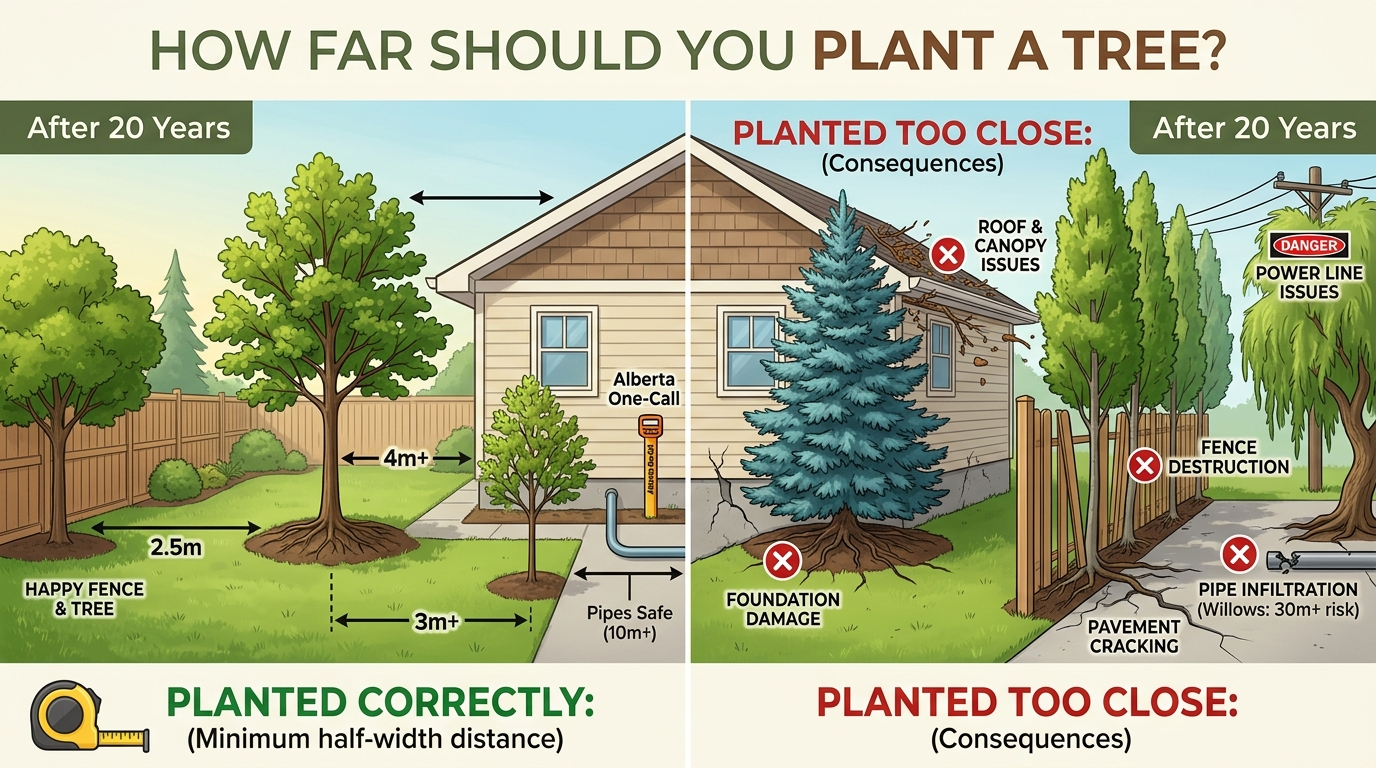
For root damage, the risk depends more on the type of tree than anything else. Trees with aggressive roots that hunt for water are the biggest risk. Willows, silver maples, poplars and Siberian elms should stay at least 10 metres from the house. More is better. These are among the fast-growing trees in Calgary that come with real trade-offs.
For spruce and pine, the roots are less aggressive but still spread out roughly as far as the tree is wide at maturity. A Colorado Blue Spruce that grows to 5 metres wide will have roots reaching at least that far from the trunk. Planting it 3 metres from the house when it will eventually be 5 metres wide creates a problem. It just takes 15 years to show up.
A useful rule: the distance from the trunk to the nearest structure should be at least half the tree’s full-grown width. So if a tree will be 6 metres wide at maturity, plant it at least 3 metres from the structure. If it will be 10 metres wide, at least 5 metres.
For overhead clearance, trees that are too close to a house will eventually grow branches into the gutters, the roof and the siding. Dead leaves pile up in gutters. Branches that rub on shingles damage them and can cause leaks. You can keep pruning them back, but if the tree is planted too close you are doing that forever.
Large trees that will top out at 10 metres or more should generally be at least 6 to 8 metres from the house. That gives the canopy room to grow without the tree becoming a roof maintenance problem every few years.
Distance From Fences
Fences attract trees, usually for privacy reasons. The problem is that a tree planted 30 centimetres from a fence is going to become that fence’s problem within a decade.
Roots grow under and around fence posts, lifting them and shifting the fence line. Trunks grow outward and start pushing against posts. Branches hang into the neighbour’s yard, which creates its own set of issues. If you’re already dealing with this, see our guide on what to do when your neighbour’s tree is dropping branches into your yard.
For a conifer that will be 4 to 5 metres wide at maturity, keep it at least 2 to 2.5 metres from the fence line. That puts the edge of the mature canopy at the fence rather than well past it.
For trees with aggressive roots like poplars or willows, you want even more distance. Their roots travel well past the canopy and will lift fence posts at distances that might surprise you.
If you are planting a privacy screen along a fence line, the right move is to plant the trees far enough back that you are not creating fence problems, and accept that the screen will sit a couple of metres from the property line. That is a much better result than a row of trees pressing into a fence and needing constant management. For species that work well as a screen, see the best trees to plant in Calgary for privacy that actually survive winters.
Distance From Driveways and Sidewalks
This is where root damage to hard surfaces is most common. Tree roots do not actually go looking for concrete to crack. But they grow where conditions are good, including under paved surfaces where the soil stays moist. As the root gets bigger, it pushes up whatever is above it.
The trees most likely to crack your driveway are fast-growing ones with shallow roots: poplars, willows and silver maples. The trees least likely to cause this are slow-growing deep-rooted ones like oaks and well-spaced conifers.
For a driveway or sidewalk, keep smaller manageable trees at least 3 metres away. For larger fast-growing species, 5 metres or more is safer. If you have seen root damage to driveways or sidewalks from trees on your street, take that as a signal about what your local soil and growing conditions produce.
If you want trees close to a driveway but are worried about roots, a few options exist: install root barriers in the soil to push roots downward, choose naturally deep-rooting species or accept that pavement eventually needs to be lifted and reset no matter what.
Distance From Buried Pipes
This is where people most often underestimate the risk because you cannot see the damage until it becomes a serious problem.
Sewer lines and water mains are the main targets. Tree roots follow moisture through the soil, and a buried pipe with even a tiny crack or a loose joint is going to attract roots from a surprising distance. Willows have been found with roots inside pipes more than 30 metres from the trunk.
Before planting any tree, call Alberta One-Call or use their online system to get your buried utilities marked. This is free and tells you exactly where buried lines run through your yard. It takes a few days to get done, so plan ahead.
As a general rule, keep high-risk trees at least 10 metres from buried water and sewer lines. Lower-risk trees should stay at least 3 to 5 metres away. If you are not sure which category your tree falls into, ask before you plant.
For gas lines, the concern is different. The issue is not roots getting into the pipe but what happens when the tree needs maintenance or falls. Trees planted very close to a gas line can have their roots disturbed during repair work. Most utilities recommend keeping at least 1 to 2 metres of clear space on either side of a gas line with no trees, and larger trees should be further back than that. For more detail, see our post on whether a tree can be too close to a gas line.
Distance From Power Lines
Trees planted under or near overhead power lines grow into them over time. The power company will trim branches away from the lines, but they do it for safety, not for the health or looks of the tree. A tree that grows into a power line gets cut in ways no arborist would recommend, often leaving it lopsided or badly shaped.
The easy answer is to not plant large trees under or near power lines. If you want something in that spot, use a small tree that will never reach line height. Flowering crabapples, Amur Cherry and some columnar varieties stay small enough to avoid the problem.
If you already have a large tree growing close to power lines, the right conversation is with an arborist about what can be managed safely and how long the tree realistically has in that location.
The Honest Version of This Conversation
There is no magic number that works for all trees and all situations. What there is, is a very common pattern: people plant trees too close to things and find out 10 to 20 years later. The tree did nothing wrong. It just grew the way trees grow.
Looking up a tree’s full-grown size before you buy it, then thinking honestly about what is nearby underground and on the surface, takes about 10 minutes. That 10 minutes can save a lot of money and frustration later. It’s also worth reviewing trees to avoid planting in Calgary yards and what to grow instead before you buy.
If you have a tree already planted and you are not sure whether it is too close to something, an arborist can look at it and give you a realistic picture of the risks and how soon they might become a problem. Reach out to Calgary Tree Works if you’d like that assessment done.
Need Professional Tree Services?
Our certified arborists are ready to help with professional tree services in Calgary.
Get Your Free Quote