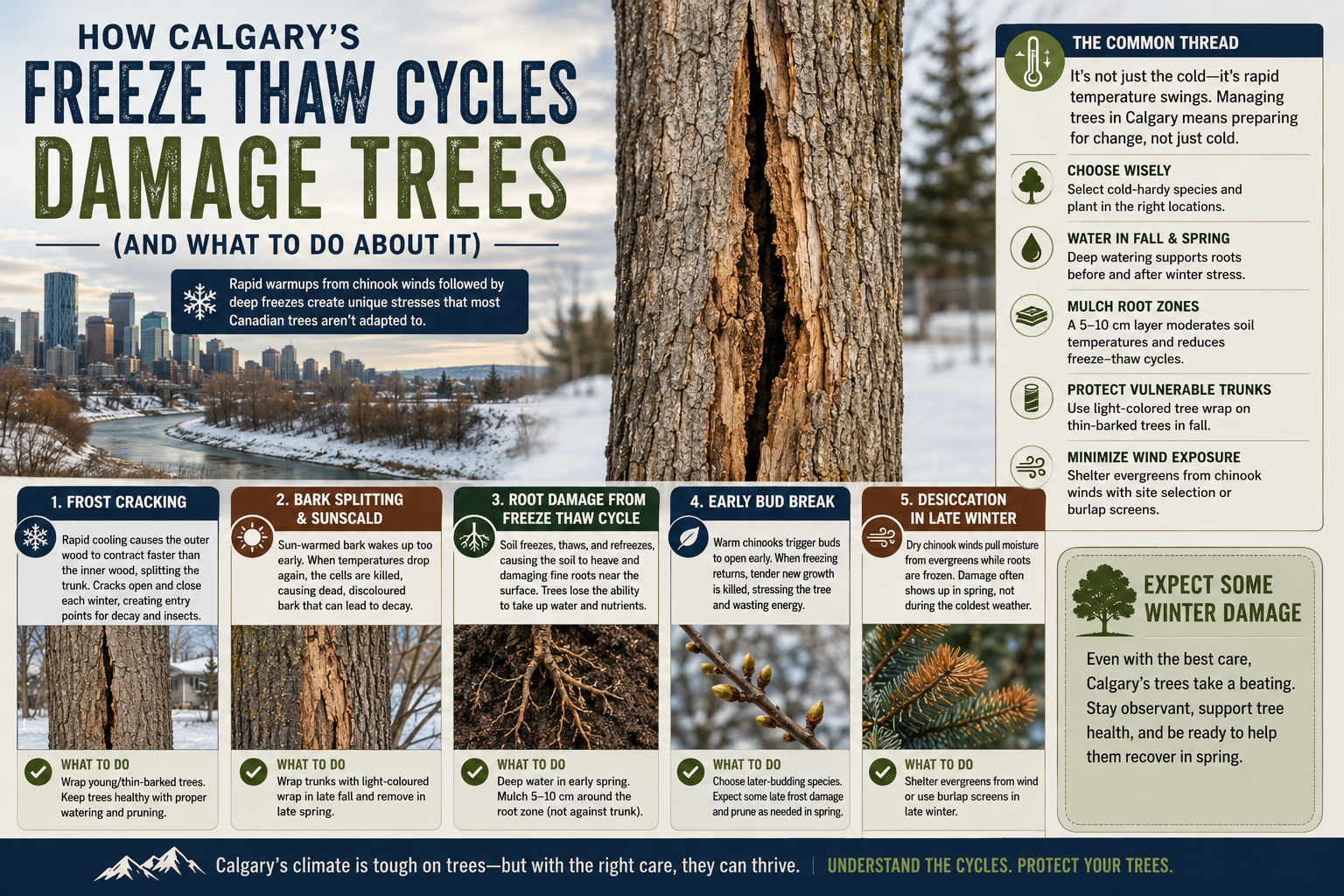
How Calgary’s Freeze Thaw Cycles Damage Trees (And What to Do About It)
Calgary’s climate is unusual in ways that matter a lot for trees. Most Canadian cities get cold in winter and stay cold until spring. Calgary gets cold, then warm, then cold again. Sometimes this cycle repeats multiple times between November and April.
That pattern is driven by chinook winds, which pour over the Rocky Mountains and can raise temperatures by 15 to 20 degrees in just a few hours. For people, a warm chinook in January feels great. For trees, it creates specific types of stress and damage that you would not see in most other Canadian cities.
Understanding what is actually happening in these cycles helps explain damage that often looks mysterious in spring. If you’re noticing unusual damage on your trees, Calgary Tree Works can help you figure out what’s going on.
Frost Cracking
This is one of the more dramatic things that happens to trees in Calgary winters. Frost cracking makes a loud cracking sound, sometimes described as a gunshot, coming from a tree trunk on a cold night.
It happens when the outer wood of the trunk cools down and contracts rapidly in cold air while the inner wood, which changes temperature more slowly, does not contract at the same rate. The tension between the outer and inner layers builds until it exceeds the strength of the wood and the trunk splits open along a vertical line.
The cracks run along the grain of the wood and can be several centimetres wide and more than a metre long. In spring, when temperatures warm back up, the wood expands and the crack closes. It looks like it has healed. But the wound site is a point of repeated stress. The same crack opens and closes over multiple winters, the wound tissue never fully seals and over time the area becomes an entry point for rot fungi and insects. This is part of why trees suddenly fall over with no warning.
Thin barked young trees are most vulnerable. Trees on the south and southwest side of properties are also more at risk because they experience the greatest difference between how warm the sun makes the bark during the day and how cold it gets at night.
There is not a lot you can do to prevent frost cracking in a susceptible tree. Wrapping the trunk of small or young trees in fall and removing the wrap in spring can reduce the temperature swings on the bark. For larger trees, keeping the overall tree healthy through proper watering and pruning gives it the best chance of containing any cracks and limiting the entry of decay.
Bark Splitting and Sunscald
Sunscald is related to frost cracking but happens through a slightly different process. On bright sunny winter days, particularly in January and February when the sun is getting stronger and snow on the ground reflects extra light upward, the south and southwest faces of tree bark can warm up considerably even while air temperatures are still below freezing.
The bark cells on that warmed side begin to wake up from dormancy. Once they do, they lose their ability to tolerate the cold. When the sun moves and temperatures drop again, often very fast in Calgary’s afternoon, those newly active cells get killed by cold they would have survived had they stayed dormant.
The result is dead, discoloured bark on the sun exposed side of the trunk. Over time that dead bark may fall off, revealing dead wood beneath. Like frost cracks, these wounds heal slowly and become entry points for decay and insects. These are among the signs your tree needs professional attention.
Young trees and trees with smooth thin bark are most vulnerable to this. Wrapping the trunk with light coloured tree wrap in late fall and removing it in late spring is the standard prevention. Light coloured wrap reflects the radiation and stops the bark from warming rapidly. This is worth doing for any thin barked tree in a sunny exposed spot in Calgary.
Root Damage From the Freeze Thaw Cycle
Soil in Calgary does not freeze once and stay frozen all winter. It freezes, thaws partially during chinooks and then refreezes, sometimes several times through the winter. This cycling causes soil to heave, meaning it moves up and down as ice crystals form and then melt.
The fine absorbing roots near the soil surface get physically disrupted by this movement. They get pulled away from the soil particles they were in contact with and lose the connections through which they take up water and nutrients. In a severe freeze thaw winter, a significant portion of a tree’s fine root system can be damaged.
This is one reason why spring watering matters for trees, even established ones. A tree that lost part of its fine root system over winter is working with reduced capacity to take up water just as temperatures warm and the tree starts demanding more. Deep watering in early spring, before the tree has fully leafed out, supports root recovery.
Mulching around trees helps moderate soil temperature and reduce how deeply and how often the freeze thaw cycle affects the root zone. A 5 to 10 centimetre layer of wood chip mulch over the root zone, kept away from direct contact with the trunk, acts as an insulator. It keeps the soil a bit warmer in early winter and slows the thaw in spring, resulting in less temperature variation in the zone where the fine roots live.
Early Bud Break
This is the freeze thaw problem that gets the most attention because it is the most visible. A warm chinook in February or March triggers bud activity in trees. Buds begin to open and the process of leafing out starts. When freezing temperatures return, those emerging buds are killed.
Some trees are more vulnerable than others. Manitoba Maple, Chokecherry and certain ornamental species tend to break dormancy earlier than spruce or pine, making them more likely to be caught by a late frost after a warm period. Trees in sheltered south facing locations warm up faster and break dormancy earlier, which increases their exposure. When choosing new trees, it’s worth reviewing trees to avoid planting in Calgary yards and what to grow instead.
There is not much you can do to stop a tree from budding out during a warm chinook. What you can do is choose species that break dormancy later, avoid planting vulnerable species in the warmest microclimates in your yard and accept that some years will produce late frost damage that needs to be cleaned up in spring.
After a late frost kills the first flush of growth, the tree usually produces a second flush from backup buds. This is stressful and uses up energy reserves, but most healthy trees recover without long term effects. Trees that were already stressed going into a late frost are more likely to struggle with recovery.
Desiccation in Late Winter
Calgary’s chinook winds are dry. When they hit in late winter, they pull moisture from anything exposed to them, including the needles and bark of evergreen trees that cannot replace that moisture because the ground is still frozen.
The damage often follows a pattern: the tree survives the actual cold of December and January without any problem and then the dry chinook driven winds of late February and March cause the damage that shows up in spring. Homeowners often assume the damage happened during the coldest weather, but it usually did not.
Evergreens on the west and south sides of properties, most exposed to the typical chinook wind direction, are the most vulnerable. Planting evergreens in spots with some shelter from the dominant wind direction or using burlap screening around vulnerable plantings in late winter, reduces their exposure to this. For species that handle these conditions well, see the best trees to plant in Calgary for privacy that actually survive winters.
The Common Thread
All of these damage types share the same root cause: rapid temperature change rather than sustained cold. Calgary’s trees are generally well adapted to cold, a pattern documented by Environment and Climate Change Canada. What challenges them is how fast temperatures change, dropping from 15 degrees to -25 in a day, then warming again, then refreezing.
Managing trees for this climate means choosing species with real cold hardiness, keeping trees well watered in fall before the ground freezes, mulching root zones to moderate temperature swings underground and being prepared to deal with some level of winter damage in spring as a normal part of growing trees in Calgary. If you’d like a professional to assess winter damage on your property, reach out to Calgary Tree Works.
Need Professional Tree Services?
Our certified arborists are ready to help with professional tree services in Calgary.
Get Your Free Quote