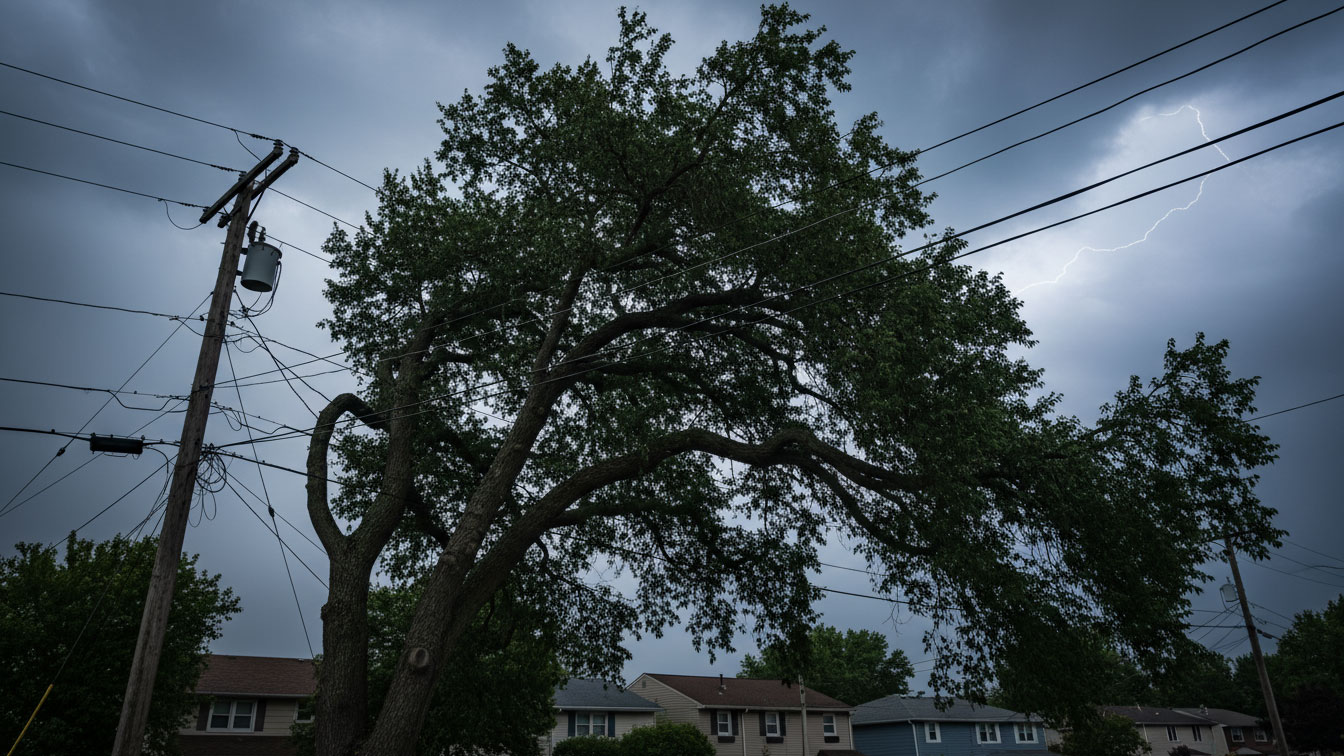
Overgrown Trees Near Power Lines: Who’s Responsible?
Trees and bushes near power lines can cause outages, fires, electrocution hazards and property damage. Who is responsible for maintaining these trees?
The answer depends on several factors, such as the location of the trees, who owns the power lines and local rules and regulations. In many cases, if the trees on your property threaten power lines, you, as the homeowner, may be responsible for their maintenance. However, if the trees are on public land or directly under utility company lines, the utility company may be responsible. We will discuss how to determine responsibility for overgrown trees and outline what you should know as a property owner. If you’re not sure where you stand, Calgary Tree Works can help clarify the situation.
Why Trees Near Power Lines Are Dangerous
This section explains why trees near power lines are particularly dangerous and outlines the specific responsibilities for preventing hazards posed by overgrown trees.
Electrical Risk: Touching a tree near power lines can cause an electric shock, especially when the tree is wet and conducts electricity. Children, workers, and residents risk serious injuries.
Fires can start from electrical shocks or when dry tree branches come into contact with power lines, especially during outdoor fires.
Power Outages: During Canadian winter storms, most areas lose power, mainly due to branches falling onto power lines. If you’re dealing with storm damage right now, see our guide on what to do in the first 24 hours after a storm hits your yard.
Property Damage: Homeowner negligence, such as failing to trim branches, can cause property damage. This can result in serious consequences such as power line disruptions, vehicle damage and other costly problems.
Do not ignore or delay action on the risks listed above. Act quickly to address any overgrown trees near power lines to protect your safety and property.
Understanding Property Lines and Utility Easements
Start by confirming your property boundaries, which will help you understand any utility easements on your property. In Canada, utility companies have the right to install powerlines on specific portions of private property.
The utility company installs utilities in a designated area of your property; however, this does not mean they own your property. It grants them only specific rights or permission to maintain and repair their equipment. To determine if utility easements exist on your property, review your property survey, title documents or contact your local land registry office.
The handling of trimming or removing trees on the property where the utility easement is installed depends on the location of the trees.
When the Utility Company is Responsible
In most areas of Canada, utility companies designate and maintain specific zones around their power lines, which they own and operate. These include both major power lines and distribution lines.
Primary Distribution Lines: If the primary distribution lines run through your property, it is usually the utility company’s responsibility to address any tree-related hazards. They have a specialised crew that patrols these areas regularly to keep on top of things and keep everything safe.
Tree Within Easement: If a tree on your property is a threat to power lines, the utility company has the right to remove or trim it. Moreover, they are bound to provide you with notice before entering your property.
Proactive Maintenance Programs: Most utility companies in Canada conduct systematic tree trimming and regularly scheduled maintenance throughout their territories. There is a different rotation time for different areas: in urban areas, it is every 5 years, while in rural areas, it is longer.
Regularly check your trees to see if they are spreading towards utility-owned lines; then inform the local utility company so they can take the necessary actions to ensure safety. There are different companies in different areas; for example, in Ontario, Hydro One and Toronto Hydro are actively working. In British Columbia, BC Hydro handles most areas. Alberta has companies like ATCO and EPCOR, whereas other provinces have their own major providers. Avoid trimming or removing trees yourself, as it is very dangerous due to power lines.
When The Homeowner Is Responsible
In some situations, property owners have responsibilities for plants and trees near utility companies’ lines.
Service Drops: The area beneath your home electrical meter becomes your responsibility, so you must arrange and pay for tree trimming and removal yourself.
Trees That Have Not Reached Lines Yet: If you want to be safe from hazards, you will maintain your trees on your own, mostly the fastest-growing trees near powerlines.
Private Power Lines: You are fully responsible for private power lines on your property; it is your responsibility to maintain and clear private power lines on time.
Secondary Damage: Liability is on you when a dead, decayed or non-maintained tree falls on power lines. You will bear all repair costs and damages resulting from service interruptions. This is one of the reasons trees suddenly fall over with no warning.
Homeowners in Canada have a clear legal duty to properly maintain their trees. Failure to do so can result in legal action if someone is injured or property is damaged due to your negligence.
Provincial and Municipal Regulations
There are different rules and regulations all over Canada for the removal of trees. Some municipalities also have tree protection laws that restrict the illegal removal of trees; these laws also apply to private properties.
Some cities require permits for tree removal, such as Toronto, Vancouver and Calgary, even though it is risky for power lines. Moreover, many jurisdictions require appropriate safety equipment and a rapid process for hazardous trees.
Check your local laws before removing the tree; some areas require permits, which you can review on the City of Calgary’s private tree permit page. In some areas, local municipalities grant permission to remove trees in emergency situations.
There are some provisional codes specifically set for clearance requirements between vegetation and power lines. These standards ensure safety during the process. Most utility companies are familiar with these codes and use them during their maintenance programs.
The Safe Approach: Whom to Call
Tree removal near power lines is not a DIY (Do-it-yourself) project; it is extremely dangerous. Instead of risking your safety, contact professionals to handle these serious situations. Follow the steps below to proceed safely:
Step 1: Contact Your Utility Company First: If there is an emergency, such as a tree falling, before taking any action, call your utility company or report the issue, including the location. The company will assess the situation; if the tree falls under their jurisdiction, they will clear it.
Step 2: Request an inspection: If this is within your responsibility, ask the utility company to visit and check the active line and disconnect power from it to ensure safe working conditions for the clearance of the tree.
Step 3: Hire Certified Professionals: Always hire a certified arborist or tree surgeon from the ISA (International Society of Arboriculture) and make sure they have insurance to cover liabilities. Learn more about what ISA certification actually means and the risks of hiring uninsured tree service contractors.
Step 4: Never Touch Lines or Trees in Contact: Don’t touch the powerlines or trees in any situation if they are in contact with each other. Even if the lines are dead.
What to Expect During Utility Tree Trimming
Here, you can expect when all work responsibility goes to the utility company:
Utility companies deploy highly trained, specialized crews. Standard procedure involves notifying all affected property owners prior to scheduling work. Crews consistently prioritize operational safety and system reliability over aesthetics. They ensure rigorous, hazard-free maintenance at all sites.
Sometimes utility companies give an asymmetrical appearance by removing branches growing near power lines and leaving those farther from the infrastructure. This is the most effective way to achieve long-term tree clearance.
Utility companies have full authority to remove an entire tree without the owners’ permission if the tree is in very poor condition, but this depends on the situation, such as if the clearance cannot be maintained through pruning. However, this is a rare occurrence and usually requires permission from legal authorities.
Cost Considerations
The property owner will not bear any cost when the utility company maintains its infrastructure on its own. The utility company will cover this cost by charging customers for electric services.
If the work is your responsibility, obtain multiple quotes and conduct all necessary verifications, such as confirming the company is insured and qualified to provide the services. There are different charges for tree removal services in Canada, ranging from hundreds of dollars to thousands, depending on the nature of the job. See our detailed breakdown in tree removal services cost, process and what to ask.
If homeowners are insured, their insurance companies may cover tree removal in certain situations. Contact your insurance company directly to find out exactly what is covered and when.
Preventions and Long-Term Planning
It is very important to know a tree’s mature size before planting it. Utility companies and experienced arborists provide proper tree-planting information and guidelines on the best locations for planting trees. This is the best way to avoid hazards from power lines. See our guide on how far you should plant a tree from your house, fence or driveway.
Here is a general rule of thumb for planting a tree, if you want to plant a low-growing tree, if you are planting it near power lines, it will be less than 25 feet tall, medium trees that can mature at 40 feet will be 40 feet away from the lines, and large trees that can mature at 40 feet will also be 60 feet away from power lines.
Schedule a consultation with a professional arborist today to keep your trees healthy, prevent costly emergencies, and protect your investment. Contact Calgary Tree Works to get started.
Need Professional Tree Services?
Our certified arborists are ready to help with professional tree services in Calgary.
Get Your Free Quote