Why Your Tree Looks Fine in Summer But Dies Over Winter
This is one of the more frustrating things that can happen in a Calgary yard. A tree looks completely healthy all the way through summer. It leaves out normally. It holds its color. Maybe you even watered it and pruned it during the growing season. Then spring comes and nothing happens. No leaves. No new growth. You wait a few more weeks and slowly accept that the tree did not survive the winter.
What went wrong? Why did the tree give no warning at all?
There are several explanations, and they depend on the tree and what was happening around it. Some causes are invisible even to a trained arborist during summer. Others leave signs that could have been caught if someone had known what to look for.
Root Problems That Do Not Show in the Canopy
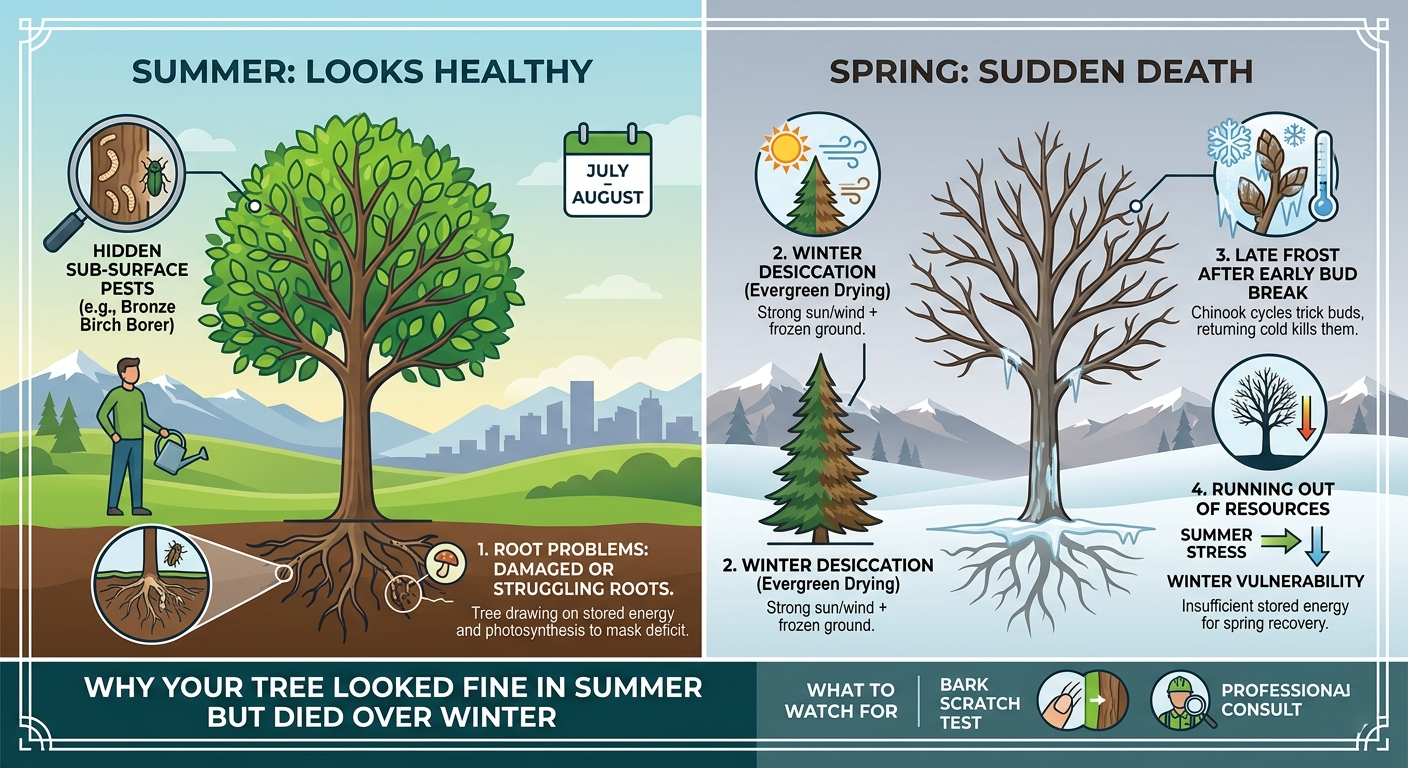
The most common explanation is a root system that was damaged or struggling well before the tree showed any visible symptoms.
Roots are the part of the tree most people never see and rarely think about. But they are where the tree gets its water and food. A tree with a seriously damaged root system can continue producing a healthy-looking canopy for one or even two full growing seasons before the canopy starts to reflect the problem.
This happens because trees store energy in their wood and bark. Even when the roots are struggling, the tree can draw on those reserves to keep the canopy growing and looking normal through summer. During the growing season, the tree is also making food through photosynthesis, which helps cover the deficit from the damaged roots.
Winter is where it all catches up. With no photosynthesis happening and the tree relying entirely on stored energy to survive the cold, a tree that has been running on a deficit all summer may simply not have enough left. It runs out of resources and does not come back in spring.
Root problems that follow this pattern include root rot caused by fungi, circling roots that have slowly cut off water flow, damage from construction or digging in previous seasons and drought stress that was never addressed.
Winter Desiccation
This is especially important for evergreen trees and shrubs in Calgary, including spruce, pine and cedar.
Winter desiccation means the tree dries out in winter. It happens when the tree continues losing moisture through its needles or leaves in late winter but cannot replace that moisture because the ground is still frozen solid. The tree is losing water faster than it can take it in, and the tissue begins to die.
This shows up most clearly in late February through April, when the sun gets stronger and the wind picks up but the ground is still frozen. You see browning on evergreen foliage, often starting on the south and southwest-facing sides where sun and wind exposure is greatest.
The confusing part is that these trees often looked completely fine through the actual cold of December and January. The damage happens in late winter, not during the deep cold, and many people mistake it for a disease or a pest problem when they discover it in spring.
Trees that were drought-stressed going into winter are much more vulnerable to this. If a tree did not get enough water through late summer and fall, it enters winter with less moisture stored in its tissue. When the sun and wind start pulling moisture out in late February, there is less reserve to draw from and the damage is more severe.
Watering evergreens deeply in October, before the ground freezes, is one of the most effective things you can do to prepare them for winter in Calgary. It is called a winter watering and it is genuinely useful, not just a sales pitch from a tree company.
Late Frost After Early Bud Break
Calgary’s chinook winds create a specific problem that most other Canadian cities do not deal with. A warm chinook in late January or February can trick trees into waking up early, opening buds and beginning to leaf out. Then winter temperatures return, as they often do in Calgary, and kill those just-opened buds.
This is visible in early spring when you see a tree with frost-damaged young leaves or buds that opened and then died. In a bad year, the tree loses almost its entire first flush of growth and has to use its energy reserves to try again. A tree that was already stressed going into this situation may not have enough left for a second attempt.
Trees that are being pushed at the edge of their cold hardiness in Calgary are the most vulnerable. But even trees that are normally hardy here can get caught by a particularly severe late frost after an extended warm period.
Pests or Disease Working Below the Surface
Some pests and diseases do their damage in places that are not visible to someone looking at the tree from the yard.
Bronze birch borer is a well-known Calgary example. The larvae of this beetle live under the bark of birch trees, feeding on the tissue just below the bark that carries water and food. A birch tree with a serious bronze birch borer infestation can look essentially normal until the feeding has progressed to the point where major branches can no longer get water through. By the time the dieback becomes obvious in the canopy, the damage is already severe.
Trees with significant borer activity often decline quickly once the symptoms appear, and winter can tip an already stressed and heavily infested tree into final failure.
What to Do If This Happened to Your Tree
If you are standing in your yard in May looking at a tree that did not leaf out and you are trying to figure out what happened, start with the scratch test. Use a knife or your fingernail to scratch a small patch of bark on a small branch. If the tissue underneath is green, that branch is still alive. If it is brown or dry, it is dead.
Work your way from the smallest branches toward the trunk. If you reach the trunk and the tissue there is still green, the tree may still have living tissue somewhere and may still produce growth, possibly from lower branches or latent buds later in the season. If the trunk tissue is brown, the tree is almost certainly dead.
For a tree that died, figuring out why it died matters for what you plant next. If it was root rot, the soil in that area may carry the fungus that caused it, and planting a vulnerable species in the same spot without treating the soil first is a risk. If it was winter desiccation of an evergreen, the same spot with the same species is probably fine as long as you do better fall watering this time around.
For trees that did not die but show significant winter damage, an arborist can assess what survived and what should be cleaned up, and give you a realistic picture of whether the tree is likely to make a full recovery or continue declining.
The Honest Take
Some of these outcomes could not have been predicted or prevented with reasonable effort. Others could have been caught earlier with better monitoring, more thorough fall watering or a professional look at a tree that was showing subtle stress signs that did not seem alarming at the time.
Calgary’s climate is hard on trees in ways that are not always obvious. It is not just the cold of January that does the damage. It is often the chinook cycles and the late-winter sun-and-freeze patterns that catch trees off guard. Understanding what your specific trees are vulnerable to, and managing them with that in mind, reduces the number of unpleasant spring surprises.
Need Professional Tree Services?
Our certified arborists are ready to help with professional tree services in Calgary.
Get Your Free Quote