Can a Tree Be Too Close to a Gas Line? What Calgary Homeowners Should Know
This question does not come up as often as trees near foundations or sewer lines, but it matters. Trees and gas lines can interact in a few different ways, and some of them are more serious than people realize.
The short answer is yes, a tree can be too close to a gas line. The concern is different from what most people expect, though. The worry is usually not that tree roots will poke a hole in a gas pipe. The worry is more about what happens when the tree needs work or removal, and about how roots and soil movement affect the line over time.
How Gas Lines Work and Why Trees Are a Concern
Natural gas lines in Calgary run underground from the main supply to homes and businesses. The bigger distribution lines that run through neighbourhoods are typically buried 60 centimetres to a metre deep. The service lines running from those distribution lines to individual houses can be shallower.
Unlike water and sewer lines, which are rigid pipes, older residential gas lines can have joints and connections that are sensitive to pressure and movement. Tree roots grow thicker over time as they age. In Calgary’s heavy clay soil, which expands and shrinks with moisture and temperature changes, root growth combined with freeze-thaw cycles can move soil around buried lines and put stress on those joints and connections.
Root intrusion into a gas pipe itself is rare. Roots do not typically push through gas pipe the way they can get into old clay sewer pipe. But roots growing alongside a line can shift it, stress its fittings or create conditions that are hard to diagnose until they become a bigger issue.
The Bigger Risk: Tree Maintenance and Removal
A more immediate concern than gradual root growth is what happens when a tree near a gas line needs to come down.
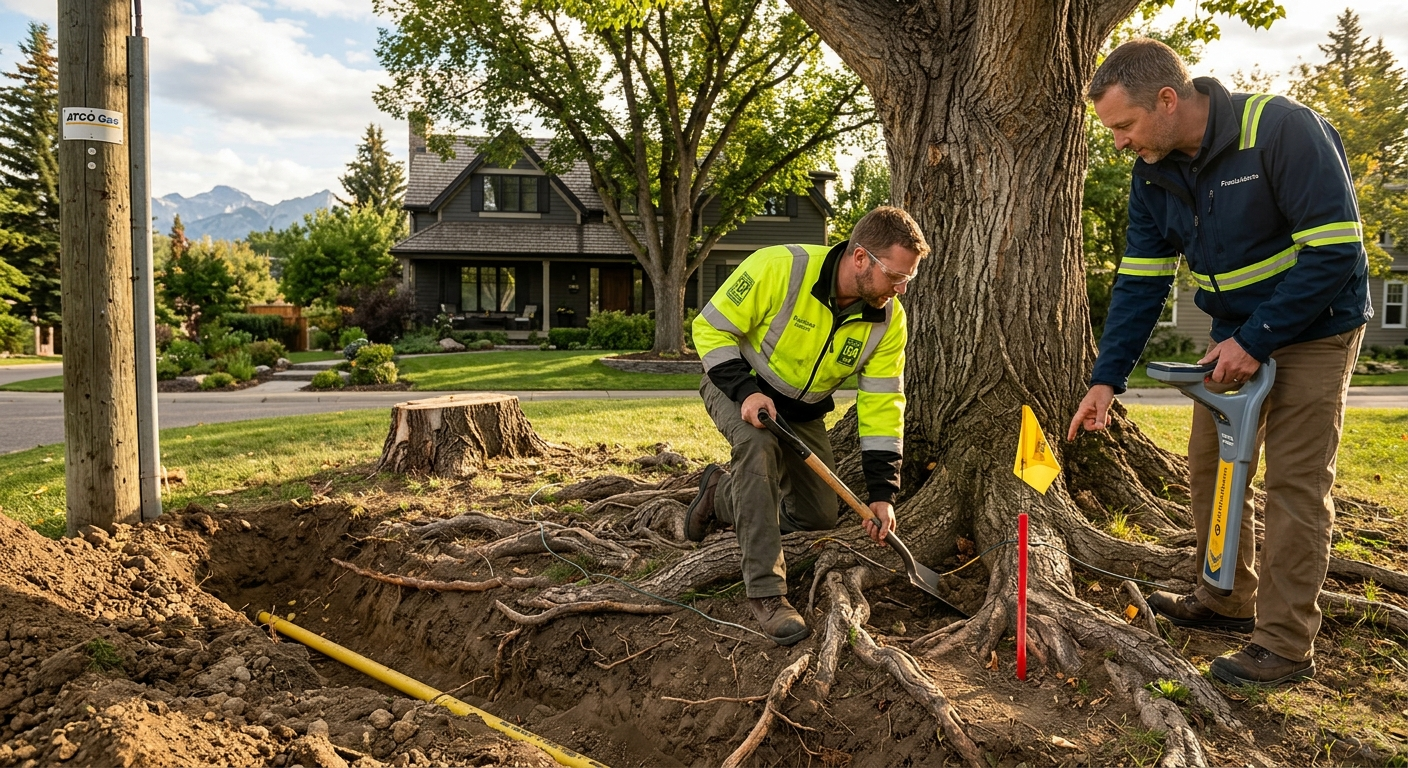
If a large tree is sitting directly over or very close to a gas line and it needs to be removed, that removal gets more complicated. The crew has to understand exactly where the line runs, make sure no machinery hits it, potentially coordinate with the gas utility to have the line precisely located and think carefully about where the tree can safely fall. All of that adds time and cost to what might otherwise be a routine job.
Stump grinding is the specific activity that creates the most direct risk. Stump grinders cut 20 to 30 centimetres into the ground, sometimes more. If there is a gas line running through the grinding zone, the risk of damage is real. Before any stump grinding near a gas line, the exact location of the line needs to be confirmed and the grinding depth managed carefully.
Finding Out Where Your Lines Are
Alberta One-Call is the free service that marks buried utilities before you dig, plant or do any ground work. You can call them or submit a locate request online. They coordinate with the utilities to have lines marked with paint or flags on the surface. The locate is valid for a set period of time.
Get a locate before you plant any tree near a potential gas line location, before any stump grinding and before any significant ground work near trees. It costs nothing and takes a few days of lead time.
One important thing to understand: a locate gives you an approximate location, not a precise one. The utility marks the line with a tolerance zone on either side. Within that zone, hand digging is required rather than using machinery. If you are working close to a marked gas line, “close” means within that tolerance zone on both sides, not just at the line itself.
What the Gas Utilities Recommend
ATCO and FortisAlberta, the main gas utilities in Calgary, have guidelines around planting near gas lines. The general guidance is to keep trees with significant root systems at least a metre from the marked gas line, and further is better.
For larger trees being considered near a gas line, the question is whether the tree’s full-grown root system will reach the line. A tree planted 2 metres from a gas line that will eventually have a 6-metre root spread is going to be growing over and around that line in a decade or two. A tree planted 5 metres away with the same root spread might stay well clear of it.
If you have a gas line running through your yard and are not sure of its path, the locate service gives you that path on the surface. It does not tell you the exact depth at every point, but knowing the horizontal path is the most important piece for planting decisions.
What to Do If You Already Have a Tree Near a Gas Line
If you have a mature tree that appears to be growing close to or over a gas line, the first step is getting the line precisely located and confirming how close the tree actually is. A rough idea of where the line runs is not precise enough to make decisions from.
Once you know the line’s exact path, an arborist can look at the tree and give you a picture of how the root system is likely positioned and whether there is real concern. In some cases, especially with older trees that grew in a particular direction, the roots may have spread away from the line rather than toward it. In other cases, the assessment will confirm that the tree and the line are close enough to manage carefully.
If the tree is healthy and not going anywhere soon, making a plan for eventual removal that accounts for the gas line is the practical approach. If the tree is declining and likely to need removal in the near future, planning that removal carefully, before it becomes an emergency, is much better than rushing it.
If You Smell Gas
If you ever smell gas near a tree or anywhere on your property, leave the area immediately, do not operate any switches or create any sparks and call ATCO Gas at their emergency number. Root-related gas line damage is uncommon but not impossible, and a gas leak is never something to investigate yourself.
The Simple Version
Trees near gas lines are not automatically a crisis. Most Calgary properties have trees and gas lines in reasonable proximity without any issues. The risks are real but manageable when you know where your lines are, you plant with that knowledge and you plan any tree work near gas lines with proper care.
Getting a utility locate before you plant trees, before you grind stumps and before any significant ground work near potential gas line areas is the most important habit to develop. The service is free, it takes a few days and there is no good reason to skip it.
Need Professional Tree Services?
Our certified arborists are ready to help with professional tree services in Calgary.
Get Your Free Quote