Back to Blog
How Big Does a Tree Have to Be Before Removal Gets Complicated (and Pricier)?
You’ve got a tree in your yard. Maybe it’s leaning a little too far toward the house. Maybe it’s dead or diseased and dropping branches every time there’s a storm. Or perhaps it’s just grown so large over the years that it’s taken over the entire backyard and now you can’t grow anything else.
Whatever the reason, you’ve decided it needs to go. And now comes the big question: how much is this actually going to cost?
The honest answer is — it depends. And the single biggest factor driving up both complexity and price is size. Not the only factor, but definitely the most important one. Understanding where the thresholds are can help you plan your budget, have a smarter conversation with your arborist and avoid any unpleasant surprises when the quote comes in. For a full breakdown of the process, see our guide on tree removal services cost, process and what to ask.
Why Size Changes Everything
Think about it from a practical standpoint. A small tree is basically a large shrub. One person with a chainsaw and an afternoon to spare can handle it. A massive oak with a trunk three feet wide and branches stretching over your roof, your neighbor’s fence and the power lines down the street? That’s an entirely different operation.
Size affects nearly every aspect of tree removal:
- How long does the job take? Bigger trees require more cuts, more rigging and more time.
- What equipment is needed? Large removals often require cranes, aerial lifts or bucket trucks.
- How many crew members are required? You can’t safely drop a 100-foot tree with one person.
- How much debris needs to be hauled away? A large tree produces an enormous amount of wood, branches and chips.
- The level of skill and planning required. Large or awkwardly positioned trees demand experienced arborists who understand rigging, weight distribution and controlled falling.
Once you understand that, the pricing tiers start to make a lot more sense.
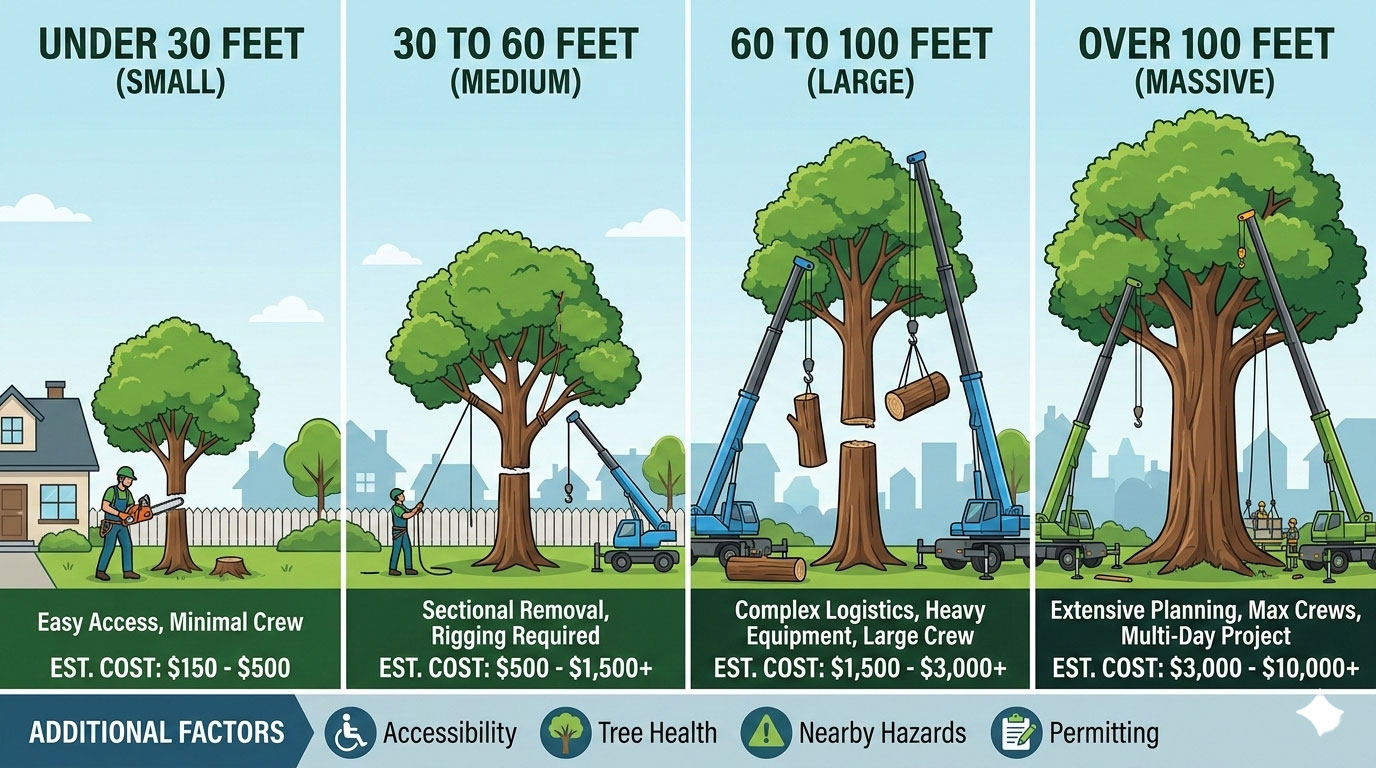
The Small Tree: Under 30 Feet
This is the category where most homeowners expect (and usually get) a pretty manageable quote. Trees under 30 feet tall, such as ornamental trees, young maples, fruit trees or overgrown shrubs, are generally straightforward to remove.
A crew can often complete the job in a couple of hours. The branches are manageable, the trunk is relatively thin and in most cases, the tree can be felled in sections without heavy equipment.
Typical cost range: $150 to $500. For example, removing a 15-foot ornamental tree might cost closer to $150, while a 28-foot fruit tree located near a fence could push the price up to $450. Costs can also increase if special cutting or cleanup is needed.
Now, even small trees can add cost if they’re in a tricky spot. A 20-foot tree growing right up against your foundation or tangled in utility lines will still require more care than the same tree standing in the middle of an open lawn. But as a general rule, small trees keep the process simple and affordable.
The Medium Tree: 30 to 60 Feet
This is where things start to get more interesting. Trees in this range include many of the most common residential species, as well as mature oaks, elms, pines, maples and ash trees. At this height, the job shifts from “one guy with a chainsaw” to a real crew with real equipment.
The biggest complication at this size is controlling where the pieces land. You can’t just cut the trunk and let the whole thing fall; there’s too much risk of damaging structures, fences, underground utilities or neighboring property. So arborists work in sections, cutting from the top down and carefully lowering each piece to the ground using ropes and rigging.
This method is slower, more labor-intensive and requires skilled workers who know what they’re doing. The equipment gets bigger, too. Aerial lifts and bucket trucks are often used, and the cleanup at the end takes considerably longer.
Typical cost range: $500 to $1,500 or more. For instance, a 35-foot maple, easily accessible from the street, may cost $600, but a 55-foot pine, tightly enclosed by structures, can reach or exceed $1,500 due to additional rigging and team hours.
The species matters more than people realize. A pine tree at 50 feet is very different from an oak at 50 feet. Oaks tend to have thicker trunks, denser wood and wider canopies that spread in less predictable directions. That density means more cuts, more debris and often more hours on site.
The Large Tree: 60 to 100 Feet
Now we’re in serious territory. Trees in this range are genuinely large. We’re talking about mature oaks, towering pines, old-growth silver maples and elms that have been growing undisturbed for decades. These are the trees that define a property and make people hesitate before calling the arborist.
At this scale, removal becomes a significant logistical operation. The trunk can be several feet in diameter. The canopy might spread 40 or 50 feet in every direction. Root systems can extend far beyond what’s visible above ground and sometimes interact with foundations, sidewalks or drainage systems.
Getting the tree down safely often requires a crane. This isn’t just to make things easier; it’s the only safe way to remove large sections of the canopy without risking serious damage to surrounding structures. Crane rental alone can add $500 to $1,000 or more to the total cost.
The crew size increases, too. A large tree removal might involve four to six workers with very specific roles: climbers in the canopy, ground crew managing ropes and debris and a crane operator coordinating the whole process.
Typical cost range: $1,500 to $3,000 or more. For example, a healthy 65-foot oak in an open yard might run about $1,700, whereas an 80-foot elm overhanging a home can exceed $3,000 because of the equipment, labor, and risk involved.
One thing that significantly affects cost in this range is whether the tree is healthy or compromised. A diseased or structurally weakened tree is actually harder to remove than a healthy one. The wood behaves unpredictably. Branches can snap unexpectedly. Sections of the trunk may not hold weight the way a healthy tree would. That unpredictability increases risk and costs. These are among the signs your tree needs professional attention.
The Massive Tree: Over 100 Feet
These trees are genuinely rare in residential settings but they do exist. Old-growth sequoias, towering Douglas firs, ancient cottonwoods along riverbeds if you have one on your property, you already know it because it dominates everything around it.
Removing a tree of this scale is a major project. It may require multiple cranes, a large crew working over several days and detailed planning to ensure the safety of everyone involved and any nearby structures. The sheer volume of material produced is staggering. A single massive tree can generate wood equivalent to several full truckloads.
Typical cost range: $3,000 to $10,000 or more. For example, removing a 105-foot cottonwood away from buildings may be $4,000, while a 120-foot fir surrounded by homes or infrastructure could quickly reach $10,000 due to required cranes, larger teams, and extra planning.
Other Factors That Compound the Cost
Size is the biggest driver, but it’s not the only one. Here are a few other factors that can push any removal into more complicated and expensive territory:
Location and accessibility. A tree in an open backyard is straightforward. A tree hemmed in by the house, a fence, a pool and power lines? Much more complex. If heavy equipment can’t get close easily, the crew has to make up for it with more manual work, which takes longer.
Health and condition. As mentioned earlier, compromised trees are harder to work with. Dead trees can be especially tricky because the wood is brittle and unpredictable.
Root systems. If you want the stump ground down or the root system removed entirely, that’s an additional cost, typically $100 to $400 for stump grinding, depending on the stump’s size, difficulty of access, and whether roots are entangled with nearby foundations or utilities. Learn more in our guide on stump removal costs, methods and what to expect.
Local permitting. In many areas, you need a permit to remove a tree above a certain size. The cost of the permit itself may be modest, but failing to get one can result in fines that far exceed what the permit would have cost. Calgary’s own rules can be found through the City of Calgary’s private tree permit page.
Time of year. Winter removals are often cheaper in regions where the ground freezes and the canopy is bare. This makes it easier to see the tree’s structure and access the property. If your timeline is flexible, asking about off-season pricing is always worth doing. See our guide on the best time to remove a tree in Calgary.
When to Call a Professional
Here’s a good rule of thumb: if a tree is taller than your house or if its canopy extends over any structure, power line or fence, you should be calling a certified arborist rather than thinking about handling it yourself.
This isn’t about being overly cautious. Tree removal at any significant scale involves real danger — falling wood, unexpected shifts in weight and proximity to structures and utilities. Professionals are trained to read a tree, plan the removal and execute it without incident. The cost of a bad outcome far exceeds what you’d save by going the DIY route.
Get at least three quotes, ask about insurance and certifications and don’t automatically choose the cheapest option. With large trees, especially, experience and proper equipment matter far more than price. Learn more about the risks of hiring uninsured tree service contractors and what ISA certification actually means when hiring an arborist.
The Bottom Line
The complexity and cost of tree removal scale dramatically with size. A small tree under 30 feet is usually a quick, straightforward job. Once you get into the 60 foot plus range, you’re looking at crane equipment, larger crews and significantly more planning. And when you’re dealing with a genuine giant the project can become a major undertaking that requires multiple days and a serious budget.
Knowing this ahead of time helps you approach the conversation with your arborist prepared. You’ll know the right questions to ask, understand why the price is what it is and make a more confident decision about how to move forward.
The tree didn’t get that big overnight. The removal won’t be simple either. If you’re ready for a quote, get in touch with Calgary Tree Works.
Need Professional Tree Services?
Our certified arborists are ready to help with professional tree services in Calgary.
Get Your Free Quote