Dutch Elm Disease in Calgary: What the Rules Mean for Your Property
Calgary has something that most North American cities have lost: a large, healthy population of American Elm trees. The reason Calgary still has them is a long-running management program that has been largely successful at keeping Dutch elm disease out. It is one of the bigger urban forestry success stories on the continent.
That success is not an accident. It comes from specific rules that apply to elm trees on private property as well as on public land, and from decades of consistent monitoring and enforcement. If you have elm trees on your property, understanding those rules is not optional. Breaking them can result in fines and can put your neighbour’s trees at risk along with your own. If you’re unsure about your elm’s condition, Calgary Tree Works can help you assess it properly.
What Dutch Elm Disease Is
Dutch elm disease is caused by a fungus that gets into the water-carrying vessels of elm trees. Once infected, the tree cannot move water through its system properly. Leaves wilt and turn yellow. Branches die back. The tree typically dies within one to three years of showing its first symptoms.
The disease spreads mainly through elm bark beetles. The beetles breed inside infected trees and carry fungal spores with them when they move to healthy trees to feed. When they feed, they create tiny wounds in the bark and those wounds let the fungus into the new tree.
This is exactly why the pruning ban is the central rule of Calgary’s elm program. Fresh pruning cuts attract elm bark beetles. If you prune an elm during the period when beetles are active, those cuts become entry points that can help spread the disease from tree to tree across an entire neighbourhood.
The Calgary Elm Pruning Ban
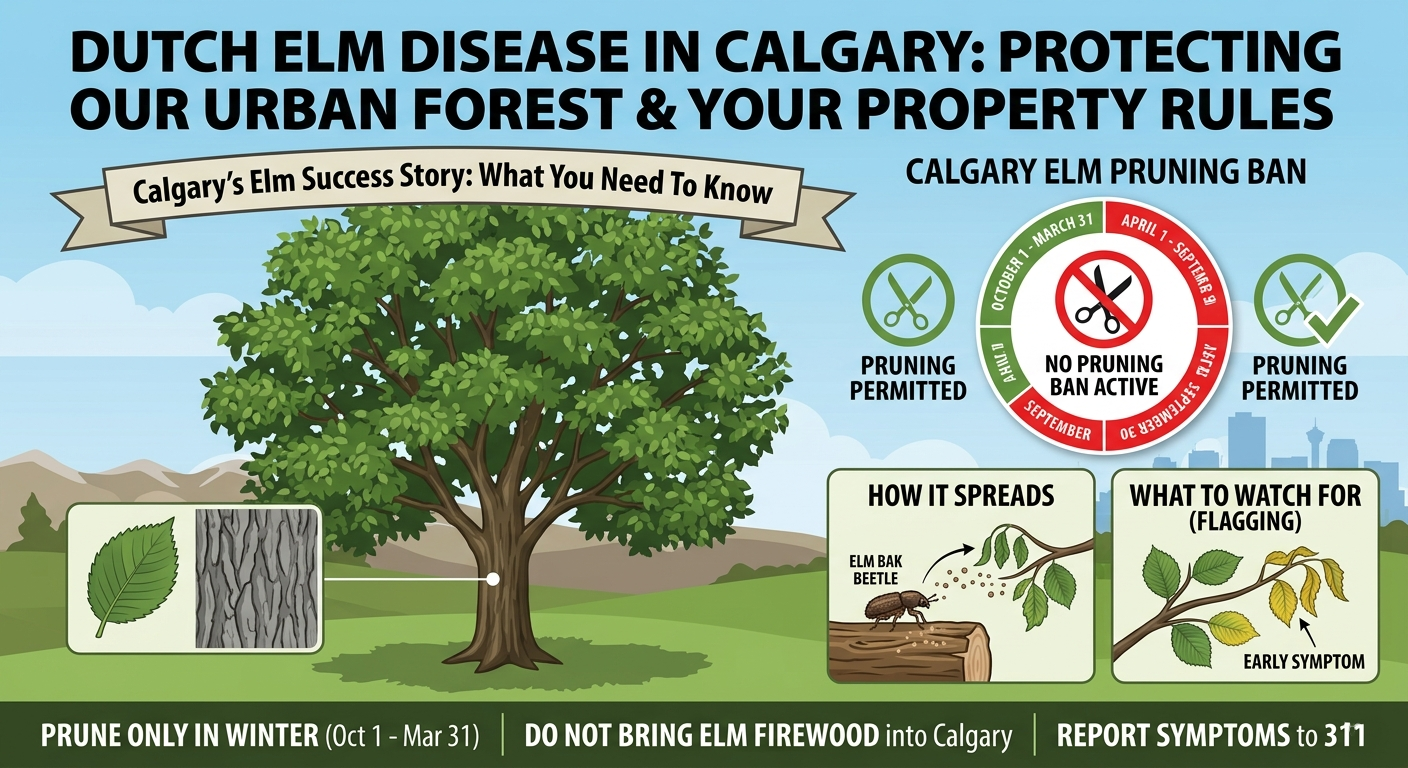
The City of Calgary bans the pruning of elm trees between April 1 and September 30 every year. This covers the window when elm bark beetles are most active and most likely to be drawn to fresh cuts. You can find the official rules on the City of Calgary’s Dutch elm disease page.
The ban covers all elm trees in Calgary, on public and private property. You cannot hire someone to prune your elm during this time and you cannot do it yourself. Pruning means any cutting of live branches, not just big structural work. This is also part of why spring is the busiest and riskiest time to book tree work in Calgary.
The permitted window for elm pruning is October 1 through March 31. During those months, elms can be pruned safely. This is a good time to consider whether your tree needs crown thinning or crown reduction.
There is an exception for genuine emergencies. If an elm branch is creating an immediate safety hazard, for example after a bad storm, it can be dealt with outside the pruning window. But this exception is for real emergencies, not for pruning that just did not get scheduled in time. See our guide on what to do in the first 24 hours after a storm hits your yard.
Knowing Whether You Have Elms
The first thing to find out is whether you actually have elm trees. In many Calgary neighbourhoods, elms are common street trees and backyard trees both, so this is not a hypothetical for a lot of people.
American Elm leaves are oval with serrated edges and an uneven base, meaning the two sides of the leaf do not match up symmetrically where it meets the stem. The bark on mature elms is grey and deeply furrowed with a ridged, almost braided look. The overall shape of a mature American Elm is often described as a vase or an upside-down umbrella, with branches arching outward and upward.
If you are not certain whether a tree on your property is an elm, having an arborist confirm the species is worth the short visit. Misidentifying a tree and then pruning it at the wrong time of year is a very easy mistake to make with real consequences. Confirming this also matters if you’re buying a home with mature trees.
What Dutch Elm Disease Looks Like
Knowing the early signs of Dutch elm disease is useful because catching it early gives the city’s management program a better chance of containing the spread.
The classic early sign is called flagging. Individual branches or sections of the canopy wilt, turn yellow or go brown while the rest of the tree still looks fine. This typically shows up in summer, starting in one section of the upper canopy and potentially spreading. Affected branches often have the tip curved downward as the tissue dies. These are among the broader signs your tree needs professional attention.
If you notice this on an elm tree, contact the City of Calgary through 311 or the 311 app. The city’s urban forestry program monitors suspected disease cases and responds to reports. Do not try to prune off the affected branches yourself. If the disease is present, cutting those branches and moving that wood around can spread the fungus further.
Infected wood has to be handled carefully. It cannot be composted or left in a pile. The city has protocols for how infected elm material gets disposed of, and those protocols matter because improperly handled wood continues to be a source of beetles and fungal spores.
Elm Firewood: A Rule People Often Miss
Bringing elm firewood into Calgary from outside the city is prohibited. Elm firewood can contain elm bark beetles, and moving that wood moves the beetles along with whatever fungus they might be carrying.
If you are bringing firewood to use in Calgary, do not bring elm wood from elsewhere. If you have elm wood on your property from a tree that was removed, it needs to be chipped, burned right away or disposed of through the city’s program rather than stacked and stored as firewood. If you’re dealing with a stump from a removed elm, see our post on what’s actually left underground after stump grinding.
What Happens If Your Elm Gets Infected
If Dutch elm disease is confirmed on your property, the city works with property owners to deal with it. For trees on public property, the city handles removal. For trees on private property, the city may require removal and the cost falls to the property owner.
This is a hard situation. A large healthy American Elm on a property is genuinely valuable, both for how it looks and for the real dollar value it adds to a property. Losing it to disease and then having to pay to remove it is a real financial hit. But it is a cost that comes with owning elms in an active disease management area. Learn more about tree removal services cost, process and what to ask.
The city’s program has worked for decades because infected trees get removed quickly, before they can become a beetle breeding ground that spreads the disease to surrounding trees. Losing individual trees is the cost of protecting the broader elm population across Calgary.
Your Part in This
Property owners play a real role in whether this program keeps working. The pruning ban only works when everyone follows it. Infected trees only get caught early when people report suspicious symptoms rather than waiting to see if the tree recovers on its own.
Pruning your elms only in the permitted window, disposing of any elm wood properly and reporting possible disease symptoms are the practical things you can do as a private property owner to be part of a program that has genuinely protected one of Calgary’s best natural assets.
Calgary’s elm population is one of the largest surviving urban elm forests in North America. That is not something many cities can say, and it took consistent effort over decades to keep it that way. If you need help caring for elms or any other trees on your property, reach out to Calgary Tree Works.
Need Professional Tree Services?
Our certified arborists are ready to help with professional tree services in Calgary.
Get Your Free Quote