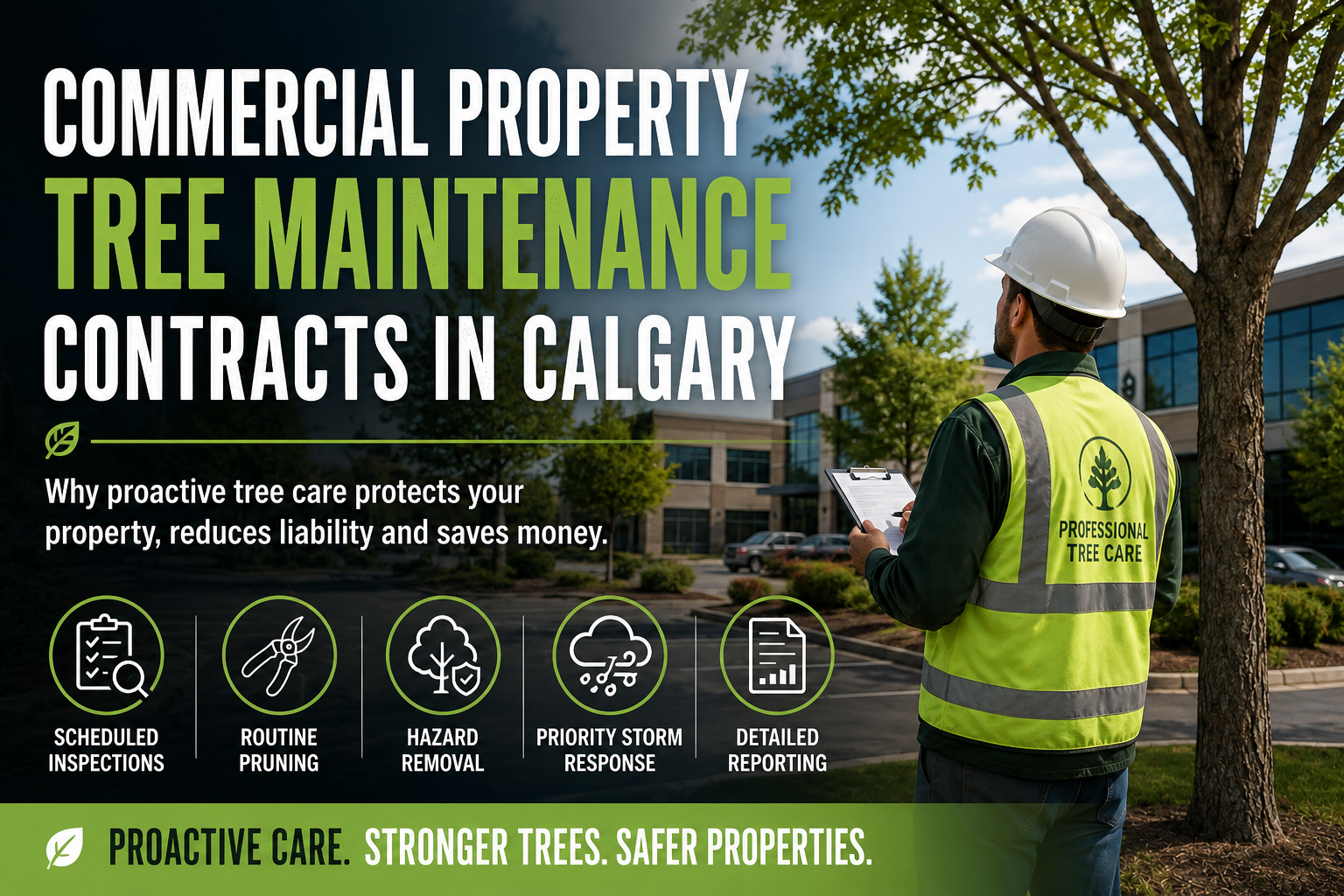
Commercial Property Tree Maintenance Contracts in Calgary
If you manage a commercial property, an HOA or a strata in Calgary, tree care is probably not the thing you think about most. It shows up on your radar when a branch drops on a walkway, when a tenant complains about a tree blocking a signor when the city sends a notice about something growing too close to a sidewalk. By the time it becomes visible, it has usually already become a problem.
A maintenance contract changes that. Instead of reacting to issues as they appear, you have a company that knows your property, checks it on a schedule and handles small problems before they turn into liability. This post explains how these contracts typically work in Calgary, what they should include and how to think about the cost versus calling for one off jobs. If you’d like a walkthrough of your property, Calgary Tree Works can help you put together a plan.
Why Reactive Tree Care Costs More Over Time
Most commercial properties end up managing trees the same way they might handle a plumbing issue, which is to say they call someone once something breaks. The problem is that trees do not fail the way pipes do. A weak limb does not usually announce itself with a warning sign before it lets go in a windstorm. By the time a tree is visibly unhealthy or clearly dangerous, the cheapest window to deal with it already closed. This is one of the reasons trees suddenly fall over with no warning.
There is also the liability side. If a property has known tree hazards and something happens, whether that is a branch hitting a parked car in the lot or a tenant slipping on debris after a storm, the property owner or management company can be on the hook. Regular inspection and documented maintenance is one of the more effective ways to reduce that exposure, because it shows a pattern of care rather than neglect.
Reactive tree work also tends to cost more per job. Emergency removals, storm cleanup and after hours calls are priced higher than scheduled work, for the simple reason that they require faster response and often happen outside normal business hours. A property that only calls when something has already gone wrong ends up paying premium rates more often than one working from a plan. Our emergency tree service is available when reactive care becomes necessary, but planned maintenance is almost always the more cost-effective route.
What a Commercial Maintenance Contract Usually Covers
Contracts vary depending on the size of the property and the number of trees involved, but most cover a similar set of services.
Scheduled inspections, usually twice a year in spring and fall, where an arborist walks the property and checks for disease, structural weakness, deadwood and anything that has changed since the last visit. This is the core of our tree health assessment service.
Routine pruning on a rotating schedule, so that trees near buildings, parking lots and walkways are kept clear of structures and sightlines without waiting for a complaint. See our tree trimming and pruning service for more on what this involves.
Deadwood and hazard removal, addressing individual limbs or trees that are identified as risks before they fail on their own.
Priority response for storm damage, meaning properties under contract typically get moved ahead of one off callers when a major weather event hits, since the company already knows the site and has history with it.
Some contracts also include seasonal services like watering during dry stretches, mulching around younger trees and reporting that documents the condition of the property’s trees over time, which is useful for insurance and liability purposes.
Who Actually Needs One of These
Not every property needs a formal maintenance contract and I want to be honest about that rather than push it as something everyone should have.
Properties with mature trees near parking areas, building entrances or pedestrian paths benefit the most, since these are the spots where a falling branch or a root heaving pavement creates real risk. Office parks, retail plazas, apartment complexes and HOAs with common green space all fall into this category.
Newer developments with young, recently planted trees also benefit, though for a different reason. Young trees need structural pruning in their early years to grow with a strong shape. Skipping this leads to weak branch structure later, which becomes an expensive problem to correct once the tree matures.
Properties with very few trees or trees that are already mature, healthy and well spaced away from structures, may not need much beyond an annual check in. In that case a straightforward yearly inspection without a full contract might be the more sensible optionand a good tree company should tell you that honestly instead of upselling a contract you do not need.
How Pricing Typically Works
Commercial contracts in Calgary are usually structured a few different way sand which one fits depends on the property.
Flat annual or seasonal rate, where the property pays a set amount covering a defined number of visits and a certain scope of work, with anything beyond that scope quoted separately.
Per visit pricing, where the property is billed each time a scheduled inspection or maintenance visit happens, without a long term commitment attached.
Tiered contracts based on tree count and property size, which is common for larger sites like retail plazas or multi building complexes where the scope can vary significantly by season.
Costs depend heavily on the number of trees, their size and the property’s overall condition. A small plaza with a dozen trees is going to be priced very differently than a large apartment complex with mature canopy throughout the grounds. Getting a walkthrough and a written proposal is the only reliable way to know what a specific property will cost and any company should be willing to break down exactly what is included at each tier.
What to Ask Before Signing a Contract
If you are evaluating a maintenance contract for a commercial property, a few questions will tell you a lot about whether the company is set up to actually deliver on it.
Ask how many inspections are included per year and what specifically happens during each one. Ask whether emergency or storm response is included in the contract price or billed separately. Ask if pruning follows ISA standards, since improper pruning can actually shorten a tree’s life and create future hazards rather than prevent them. Learn more about what ISA certification actually means when hiring an arborist. Ask for references from other commercial or strata properties they currently service in Calgary. Ask how quickly they can respond to an urgent issue for contract clients versus non contract callers, since priority response is one of the main reasons to sign a contract in the first place.
A company that has done this kind of work for other commercial clients will have straightforward answers to all of this. Vague answers or reluctance to put terms in writing is worth treating as a warning sign. This is also worth checking against our guide on the risks of hiring uninsured tree service contractors.
How Contract Length and Terms Usually Work
Most commercial tree maintenance agreements in Calgary run on an annual basis, renewing each year unless either party gives notice. Some companies offer a shorter initial term, often six months or a single season, so a property can try the service before committing to a longer agreement. This is worth asking about directly if you are unsure whether a full year contract makes sense right away.
Cancellation terms vary between providers and it is worth reading this section of any proposed contract carefully rather than skimming it. Some companies require thirty or sixty days notice before cancellation, while others allow month to month arrangements with no long term lock in. Neither approach is inherently better, but knowing what you are agreeing to avoids an unpleasant surprise if your needs change partway through the year.
It is also common for contracts to include a clause about scope changes, meaning what happens if new trees are planted on the property, an existing tree needs to be removed entirelyor the property expands. A well written contract should spell out how these changes affect pricing rather than leaving it ambiguous. If a removal does become necessary, see our guide on tree removal services cost, process and what to ask.
Seasonal Considerations Specific to Calgary Properties
Commercial properties in Calgary face a specific set of seasonal pressures that make regular maintenance more valuable than it might be in a milder climate. Our freeze thaw cycles through late winter and early spring put real stress on trees, particularly younger ones or species not well suited to the prairiesand this stress often shows up as dieback or structural weakness that would not be obvious without a trained eye checking the property. See our guide on why your tree looks fine in summer but dies over winter.
Summer hail and windstorms are another factor property managers deal with regularly. A property under an active maintenance contract typically has documented tree conditions from the most recent inspection, which makes it much easier to assess storm damage accurately and separate new damage from pre existing conditions when dealing with insurance.
Winter itself brings its own risk, particularly heavy wet snow loading on branches that were not properly thinned or pruned beforehand. Properties that get a fall inspection and deadwood removal before winter tend to come through heavy snow events with far less damage than properties where trees went into winter unchecked.
Documentation Matters More Than People Realize
One benefit of a formal contract that often gets overlooked is the paper trail it creates. Every inspection report, every pruning record and every hazard assessment becomes part of a documented history for the property. If a tree related incident ever does happen and there is a liability question, having records that show the property was inspected regularly and maintained by a professional company matters. It is the difference between being able to show a pattern of reasonable care and having nothing to point to at all.
For strata councils and property management companies specifically, this documentation is also useful when budgeting. Instead of tree related expenses showing up as unpredictable emergency costs, they become a known line item that can be planned for annually, which makes financial reporting to owners or boards much simpler.
Getting Started
If your property has never had formal tree maintenance and you are not sure where to start, the simplest first step is a walkthrough assessment. This gives you a clear picture of what is actually on the property, what condition it is in and what a realistic maintenance plan would look like, without committing to anything upfront.
For properties that have been putting off tree care and are dealing with the first signs of trouble, whether that is deadwood, root heaving near walkways or complaints from tenants, that assessment usually reveals more than expected. It is almost always cheaper to address these things on a planned basis than to wait for an emergency call.
If you manage a commercial property, HOA or strata in Calgary and want to know what a maintenance plan would actually look like for your site, get in touch with Calgary Tree Works and we can walk the property with you and put together a straightforward proposal based on what is really there.
Need Professional Tree Services?
Our certified arborists are ready to help with professional tree services in Calgary.
Get Your Free Quote