Back to Blog
5 Signs Your Tree Needs Professional Attention (Don’t Wait Until It’s Too Late)
5 Signs Your Tree Needs Professional Attention (Don’t Wait Until It’s Too Late)
Most homeowners are not trained about tree health, as trees are remarkable living beings. So this will be the hardest challenge that trees communicate distress in subtle ways thats why when homeowners are aware of their tree problems, they have already experienced internal damage occurring. This will be the hardiest specimens growing in Calgary’s homeowner’s yard.
A professional arborist is perfectly trained and can easily detect these warning signals before a tree reaches to its severe condition where it can not return to its good health. You can save thousands of dollars and protect your property, your family, and your neighbours from heavy damage by knowing when to call for help. Below are the five critical signs that indicate that your tree needs immediate professional help.
Sign 1: Unusual Bark Damage, Cracks, or Fungal Growth
The tree’s first line of defense is its bark, which will protect against disease, pest and environmental stress. So the deep cracking in the bark will not be the normal issue, like in Calgary’s climate, free thaw cylces will cause frost cracking, characterized by long, vertical splits. Deep fissures will penetrate the wood, allowing moisture and pathogens to cause serious damage.
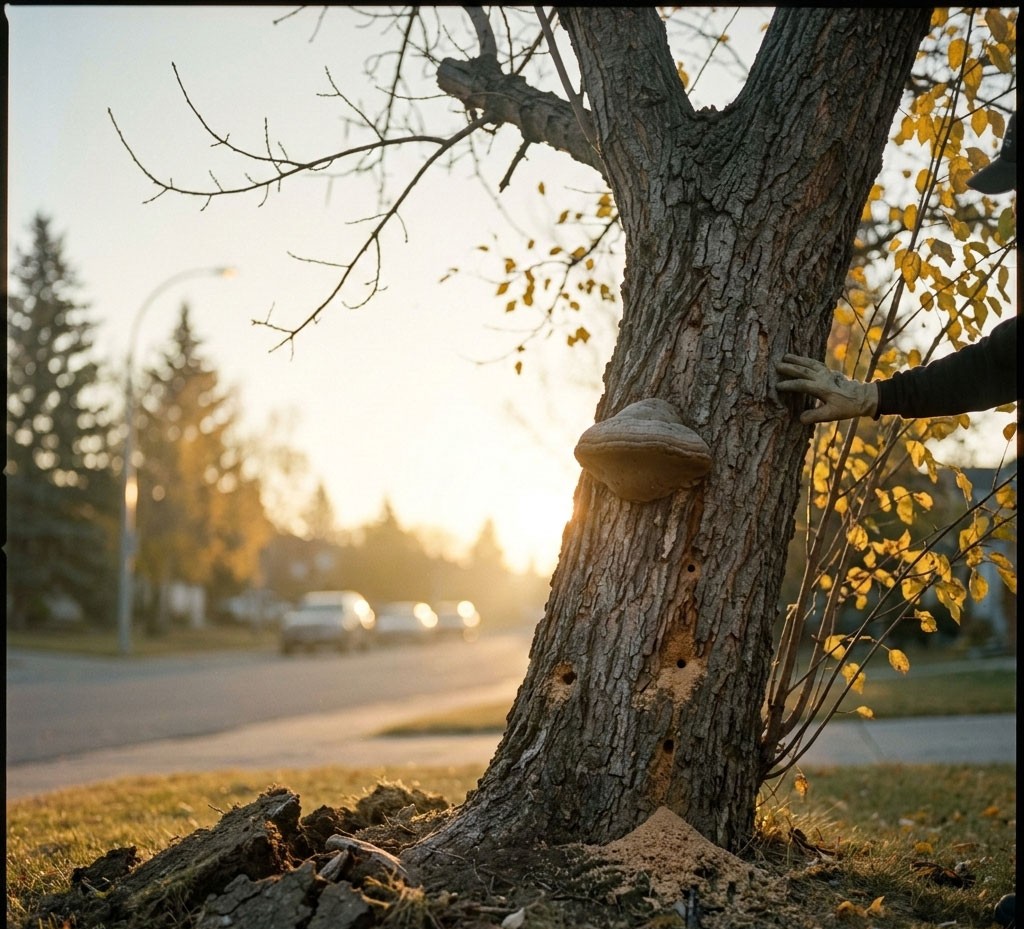
The most alarming situation is the presence of fungal conks or the growth of rounded mushroom at tree trunks and near the roots. The reproductive structures of wood decay fungi indicate severe internal rot. The conk becomes visible externally over time. A trained arborist uses various methods, including resistance drilling and sonic scanning, to determine whether the tree is structurally safe.
Another warning sign is damaged areas of bark which look which look discolored or sunken. In Alberta, Cytospora canker can spread rapidly through trees once it appears. Consult a professional arborist as soon as possible after noticing these irregularities.
Sign 2: Sudden or Progressive Leaf and Foliage Changes
Sudden changes in a tree’s leaves can lead to trouble. Yellow or brown leaves appearing too early, leaves that stay small or curl or branches that fail to grow leaves at all, often mean the tree is under stress, even though healthy trees normally produce full, green foliage during the growing season. Sometimes the cause is minor, but at other times it is straightforward, such as drought stress, nutrient deficiency or compacted soil.
Chlorosis, the yellowing of leaves due to iron or manganese deficiency, is extremely common in Calgary because of the high pH levels of prairie soils. While it can be treated with soil amendments and trunk injections, a professional diagnosis is required to determine the specific deficiency and the appropriate course of action. Similarly, premature leaf drop, sparse canopy development, or a pattern of dieback from branch tips inward (called flagging) are all signs warranting a professional evaluation.
Dutch Elm Disease, one of the most devastating tree diseases in North America, causes exactly this kind of progressive wilting and flagging. Calgary has an important Elm protection program precisely because this disease can sweep through a neighborhood rapidly. If you notice one-sided wilting or leaves browning and curling mid-season on an elm, do not wait to contact an arborist; early intervention can sometimes save an infected tree and almost certainly protect surrounding trees.
Sign 3: Dead, Dying, or Hanging Branches
Dead branches are not just an aesthetic problem. They are safety hazards and potential entry points for pests and disease. A dead branch, sometimes called a ‘widow maker’ by arborists, can fall without warning, especially during wind events, ice storms, or heavy snowfall, all of which Calgary residents know intimately well. Dead wood loses flexibility and can break under weight or stress that living wood would handle easily.
Identifying dead branches is not always as straightforward as it sounds. Scratch the bark lightly with a fingernail. Living branches will show green tissue underneath; dead branches will show dry, brown wood. Check for buds in spring: healthy branches will produce buds; dead ones will not. Look for branches that retain dried, brown leaves long after surrounding branches have gone dormant or leafed out fully. Any of these signs indicates that a trained arborist should assess the tree and safely remove the hazardous limbs.
Sign 4: Visible Lean or Root Problems
Trees naturally grow with slight angles in response to light and wind loading, but a sudden or pronounced lean, particularly one that has developed recently, is a serious warning sign. When a tree suddenly begins leaning, it often indicates root failure on the opposite side, whether caused by disease, soil erosion, construction damage or simply an aging root system that can no longer anchor the tree against wind load.
Soil heaving around the base of a tree is another critical indicator that the roots are lifting and failing. If you notice raised soil, cracked ground, or exposed roots on one side of the tree near the base, the tree’s stability is compromised. This is particularly common in Calgary after periods of wet weather followed by freezing, when repeated freeze thaw action can destabilize roots already weakened by decay or damage.
Root problems are notoriously difficult for homeowners to assess because the majority of a tree’s root system extends far beyond what is visible. A certified arborist can perform a root crown excavation or use air spade technology to expose and examine the root structure without causing additional damage, providing a clear picture of the tree’s overall stability and the remediation options available.
Sign 5: Pest Activity and Insect Infestations
The presence of insect pests in your trees is not always immediately obvious, but the signs of their activity usually are. Bore holes in the bark, small, perfectly round or D-shaped entry points are the calling card of wood-boring beetles, including the Bronze Birch Borer, a significant threat to birch trees throughout Alberta. Galleries of sawdust-like material (called frass) beneath the bark, or piles of coarse sawdust at the base of a tree, indicate that borers are actively at work.
Other visible pest signs include galls (abnormal growths caused by gall-forming insects or mites), webbing from tent caterpillars or fall webworms, sticky honeydew residue on leaves and surfaces below the tree (a sign of aphids or scale insects), and the presence of large numbers of a particular insect on or near the tree. The sooner an infestation is identified and professionally treated, the greater the range of treatment options available.
Waiting too long to address these five warning signs almost always means higher costs, fewer options, and greater risk. A professional arborist consultation is typically far less expensive than emergency tree removal, property damage repair or the legal and insurance headaches that can arise when a neglected tree causes harm. When in doubt, always call a certified arborist. Your trees, your property and your peace of mind are worth it.
Need Professional Tree Services?
Our certified arborists are ready to help with professional tree services in Calgary.
Get Your Free Quote